
Most businesses have a revenue problem that looks like a sales problem or a marketing problem but is actually a systems problem. A RevOps framework can help by aligning your sales, marketing, and customer success teams around shared data, shared processes, and shared goals. This guide walks through exactly how to build a RevOps strategy from scratch, even if you are starting with no formal structure in place.
“We had a marketing team generating leads, a sales team closing deals, and a customer success team retaining accounts. None of them were using the same data, none of them agreed on what a qualified lead looked like, and nobody could tell us what our actual revenue forecast was. That is not a people problem. That is a systems problem.”
Revenue Operations is not a job title or a department. It is a operating model that brings your sales, marketing, and customer success functions under a single strategic framework with shared data, shared technology, and shared accountability for revenue outcomes. When it works, your pipeline is predictable, your handoffs are clean, and every team is pulling in the same direction. When it does not exist, you get the situation above: three teams working hard in three different directions and a leadership team that cannot forecast with confidence.
Building a RevOps strategy from scratch does not require a dedicated RevOps hire on day one. It requires a clear sequence of decisions and implementations that most businesses can work through in 90 to 120 days with the right framework. This guide gives you that framework. If you want to understand the full case for why RevOps matters before diving into the build, our post on what RevOps actually is covers the foundations in detail.
Signs Your Business Needs a RevOps Strategy Now
Most businesses do not decide to build a RevOps strategy because they read an article about it. They decide because something is visibly broken and they cannot figure out exactly where the break is. These six symptoms are the most common signals that a RevOps strategy is the missing piece. If your business has three or more of them, the problem is structural and no amount of hiring or campaign spending will fix it without addressing the underlying system first.
Revenue Is Unpredictable Quarter to Quarter
When deals slip and forecasts miss, the issue is usually inconsistent data and process rather than sales effort. A shared view of the buyer journey makes the problem visible.
Sales and Marketing Blame Each Other
Marketing and sales need one definition of a qualified lead and one agreed handoff. Without them, both teams optimise different outcomes.
Your CRM Data Is Unreliable or Incomplete
Duplicate contacts, inconsistent stages, and incomplete records make reporting unreliable. Clean CRM standards are the baseline for sound decisions.
Customer Handoffs Between Teams Are Messy
A closed deal should carry the right context into onboarding. Shared handoffs prevent customers repeating themselves and reduce early churn risk.
Your Tech Stack Has Grown Without a Plan
An unowned stack creates silos, manual work, and avoidable cost. Each tool needs a defined role in the wider revenue system.
Nobody Agrees on Which Metrics Matter
Teams need a common view of the metrics that shape revenue. Shared reporting connects activity to decisions and investment.
What a RevOps Strategy Actually Covers
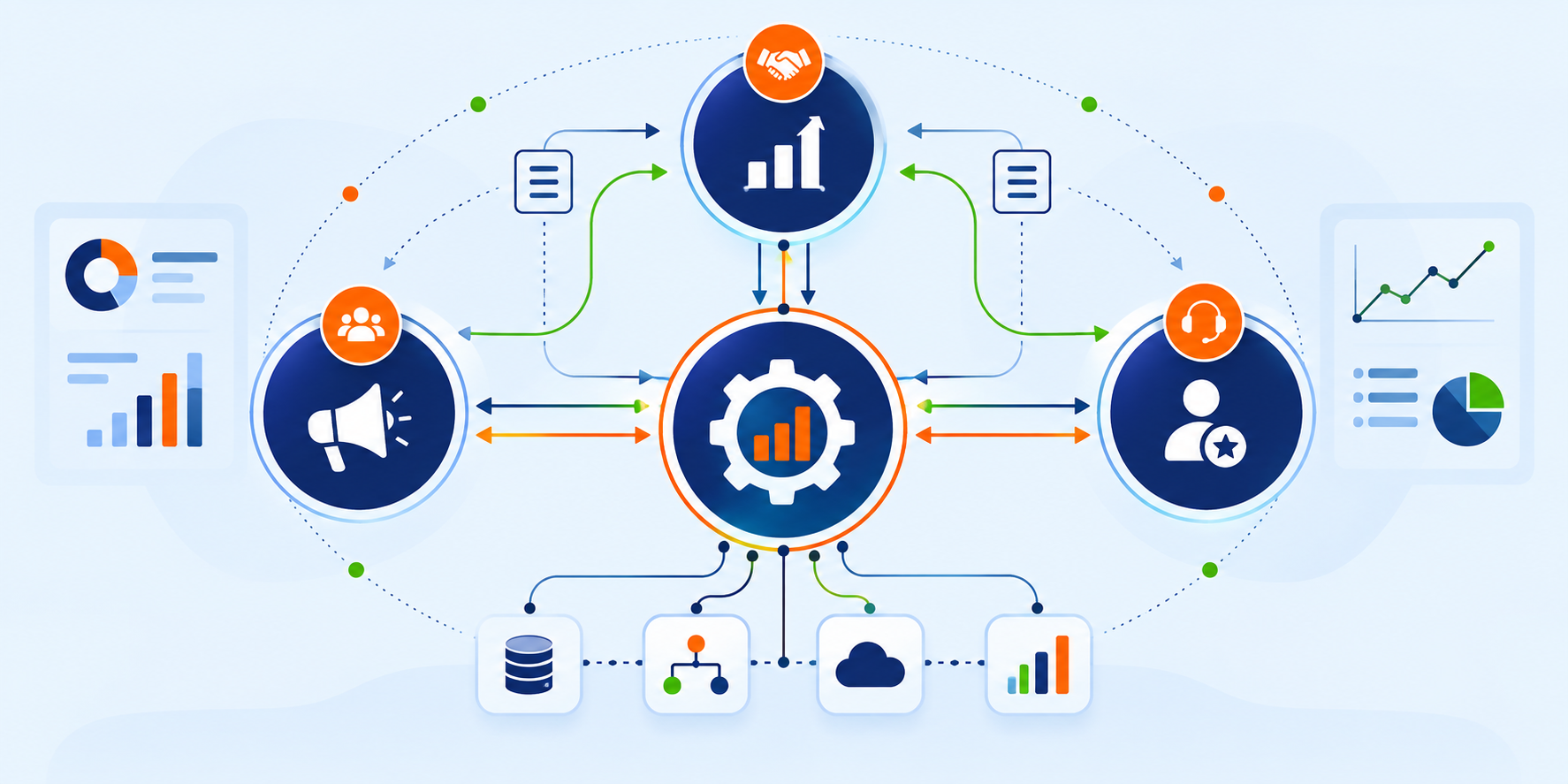
RevOps brings data, process, technology, and reporting into one operating model. Each pillar supports the others, so a tool purchase or single hire alone cannot solve a structural problem. Explore our RevOps framework for the wider service approach.
What It Covers
What Breaks Without It
How to Build Your RevOps Strategy Step by Step
Work through these six steps in order. Each one builds on the previous. Most businesses try to start with technology and skip the first two steps entirely, which is why their RevOps implementations fail to produce the results they expected. The sequence matters as much as the individual actions. For help building a B2B marketing strategy that connects to your RevOps framework, that guide covers the marketing side of the same system.
Audit Your Current Revenue Process End to End
Map every handoff from first touch through onboarding. Record where data is captured, lost, or handled differently so the real gaps are clear.
Start Here
Define Your Shared Definitions and Stage Criteria
Agree MQL and SQL definitions, pipeline entry and exit rules, and the sales-to-customer-success handoff. Document them as one shared standard.
Alignment
Clean Your CRM and Establish Data Standards
Remove duplicates, standardise stages and sources, and define required fields. Assign ownership so data quality does not fade after launch.
Data Quality
Build Your Automation and Workflow Layer
Automate only the process you have already agreed: lead routing, stage updates, handoff notices, follow-up, and renewal alerts.
Automation
Build Shared Reporting That Every Team Uses
Build shared CRM dashboards for pipeline, conversion, velocity, acquisition cost, and retention. Every team should work from the same numbers.
Reporting
Establish a Cadence for Reviewing and Improving the System
Review data quality, workflow performance, and pipeline health monthly. Use a quarterly review to improve the stack, process, and reporting.
Continuous Improvement
RevOps Implementation Checklist
Use this checklist to track your progress as you work through the build. Each item represents a concrete output, not a vague goal. If you cannot point to a specific document, dashboard, or workflow for each item, it is not done yet. Treat this as your 90-day implementation tracker.
The businesses that implement RevOps successfully are not the ones with the biggest budgets or the most sophisticated tools. They are the ones that do the unglamorous work first: mapping their process, agreeing on definitions, and cleaning their data before touching any technology. The tool layer is the easy part. The alignment and discipline that makes the tools work is where the real work happens.
-
RevOps is not a tool or a job title. It is an operating model that aligns sales, marketing, and customer success around shared data, shared processes, and shared accountability for revenue outcomes.
-
The most common RevOps mistakes are starting with technology before fixing process, and trying to automate workflows before the underlying data is clean. Sequence matters more than speed.
-
Shared definitions of MQL, SQL, pipeline stages, and handoff criteria are the foundation of RevOps alignment. Most businesses have never agreed on these explicitly, and that absence is the root cause of most sales and marketing conflict.
-
Shared reporting that every team uses is the mechanism that keeps RevOps working over time. When everyone looks at the same numbers in the same place, the conversation shifts from whose data is right to what to do about it.
-
RevOps is a continuous improvement programme, not a project with a finish line. The monthly and quarterly review cadence is what separates businesses that sustain the gains from those that regress within six months of implementation.
Frequently Asked Questions
How long does it take to build a RevOps strategy from scratch?
Do I need to hire a dedicated RevOps person to get started?
Which CRM works best for a RevOps setup?
What is the difference between RevOps and Sales Ops?
How do I know if my RevOps strategy is working?