

Every week, thousands of businesses search for the same answer: HubSpot or Salesforce? It is one of the most researched technology decisions in B2B, and for good reason. Both platforms are genuinely excellent. Both have transformed how companies manage their sales and marketing operations. And both have also been implemented badly, adopted poorly, and abandoned expensively by businesses that chose the wrong one for the wrong reasons.
We have implemented both platforms across hundreds of clients since 2011. We have seen HubSpot work brilliantly for fast-moving growth teams and we have seen Salesforce deliver extraordinary value for complex enterprise operations. We have also seen the reverse: Salesforce deployments that overwhelmed small teams and HubSpot implementations that hit their limits as businesses scaled.
HubSpot and Salesforce are the two most compared CRM platforms in the world. HubSpot wins on ease of use, faster implementation, and unified marketing and sales tools. Salesforce wins on deep customisation, enterprise scalability, and reporting complexity. The right choice depends entirely on your team size, technical capability, and what you actually need the CRM to do.
The HubSpot vs Salesforce debate has been running for over a decade and it still does not have a single right answer. Both platforms are genuinely excellent. Both have helped thousands of businesses build more efficient revenue operations. The question is never which platform is better in the abstract. The question is which platform is better for your specific business, your specific team, and your specific goals.
As a team that has implemented both platforms across hundreds of clients, our view on HubSpot CRM and Salesforce is grounded in what we see working and failing in practice rather than in platform marketing materials. This guide gives you the honest comparison.
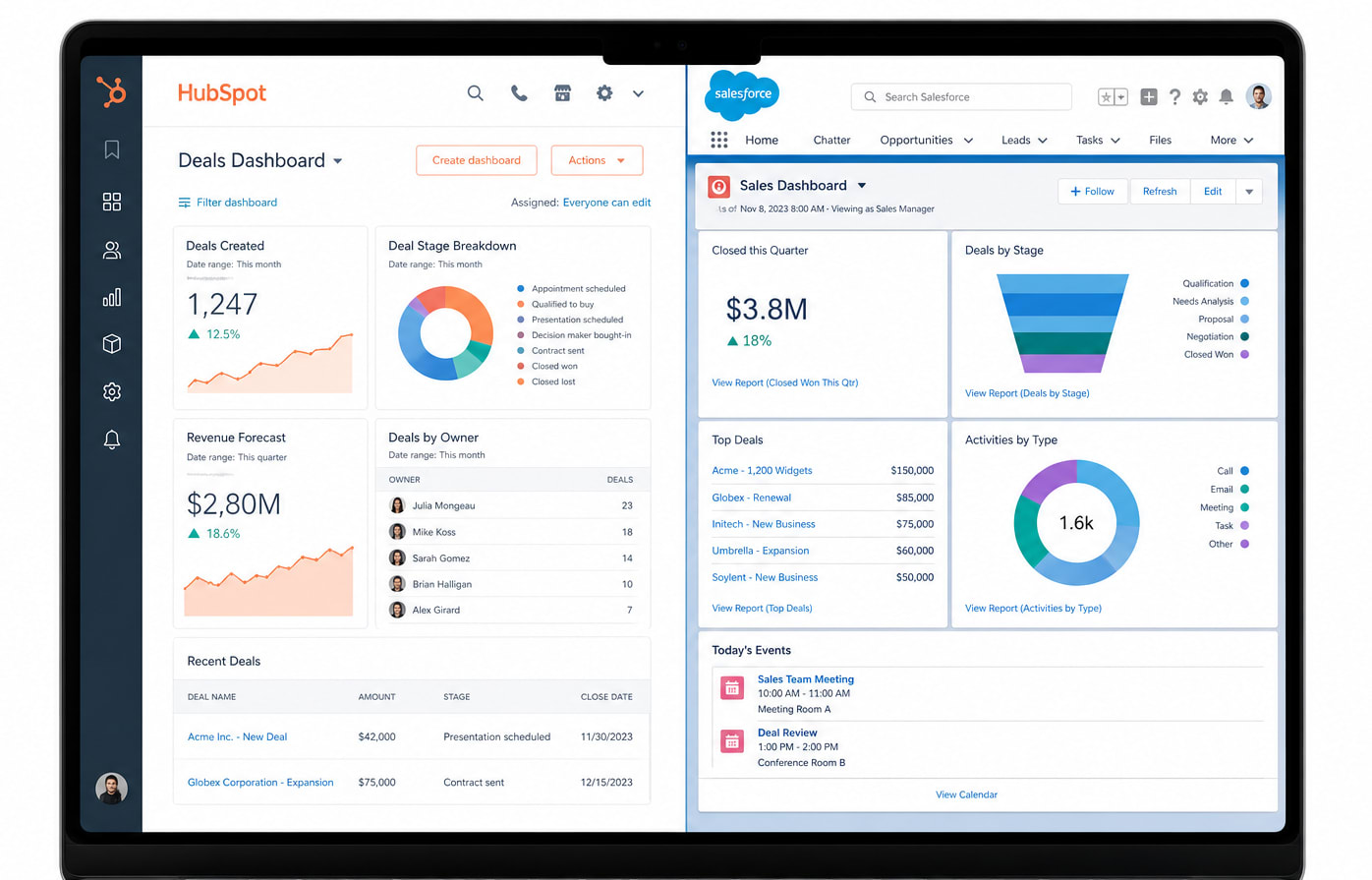
Where HubSpot and Salesforce Are Fundamentally Different
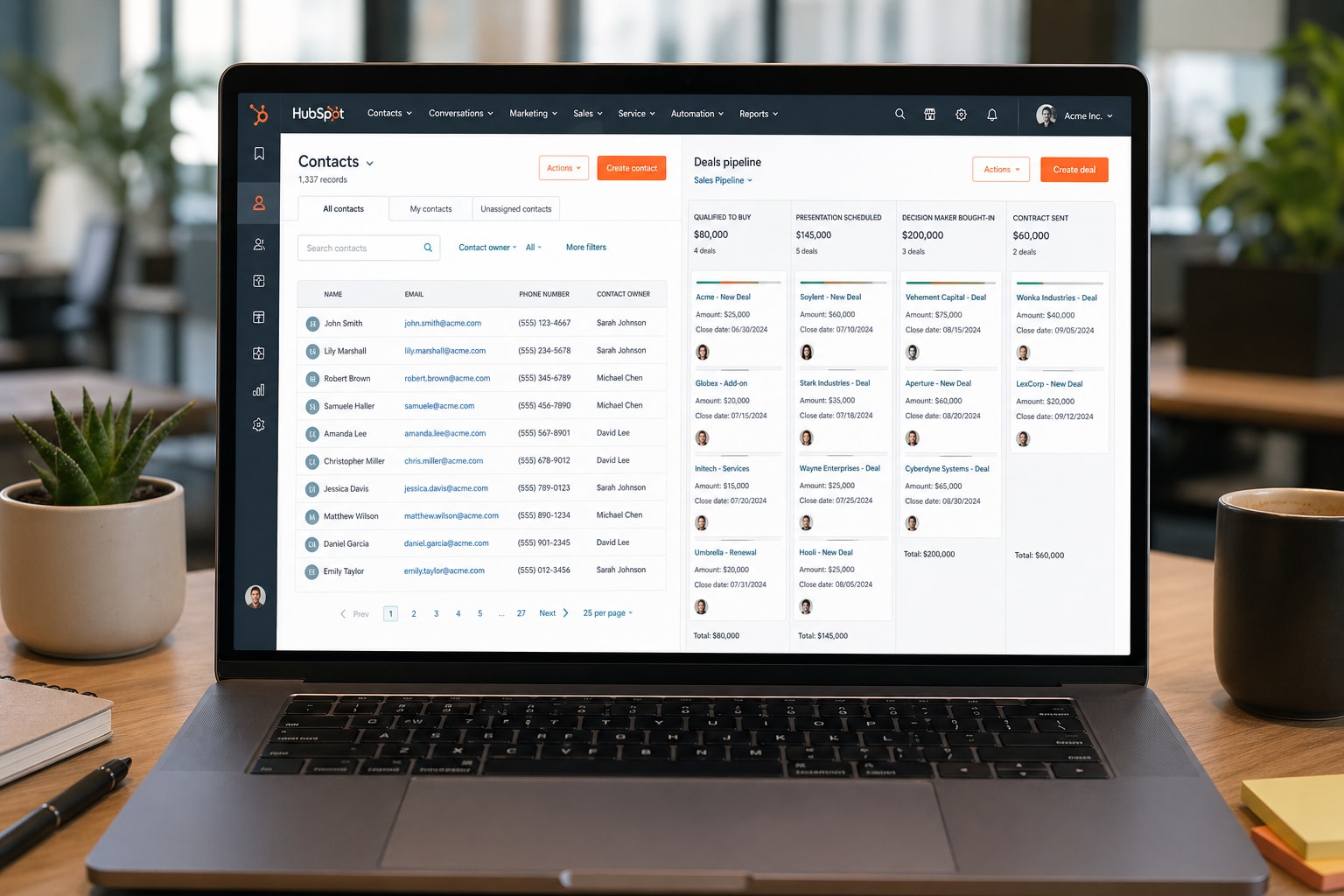
HubSpot Strengths: Where It Wins
Ease of Use and User Adoption
HubSpot consistently earns the highest user satisfaction scores of any CRM platform in its category. The interface is clean, logical, and designed for salespeople rather than administrators. New users are typically productive within days rather than weeks. This matters enormously in practice. A CRM that gets adopted delivers value. A CRM that feels complicated gets worked around with spreadsheets. The user adoption rate difference between HubSpot and Salesforce is one of the most consistent findings across CRM implementation projects.
HubSpot AdvantageUnified Marketing and Sales Platform
HubSpot's biggest structural advantage is that marketing automation, CRM, sales tools, and customer service all live in a single platform with a single database. A marketing lead flows into CRM without any integration work. A sales rep can see every marketing email a prospect opened before they booked a call. Attribution reporting connects marketing spend to closed revenue automatically. In Salesforce, achieving this same connected view requires integrating Marketing Cloud, Sales Cloud, and Service Cloud, which are separate products that require significant setup and ongoing maintenance.
HubSpot AdvantageImplementation Speed and Cost
A HubSpot implementation for a small to mid-size business typically takes four to eight weeks and can be handled by a certified partner without a large internal IT team. The HubSpot CRM implementation process is well-documented, the platform is designed to be configured without code, and the onboarding resources are genuinely good. A comparable Salesforce implementation for the same business size typically takes three to six months and requires significantly more technical resource. For businesses that need to move quickly, this difference alone often determines the platform choice.
HubSpot Advantage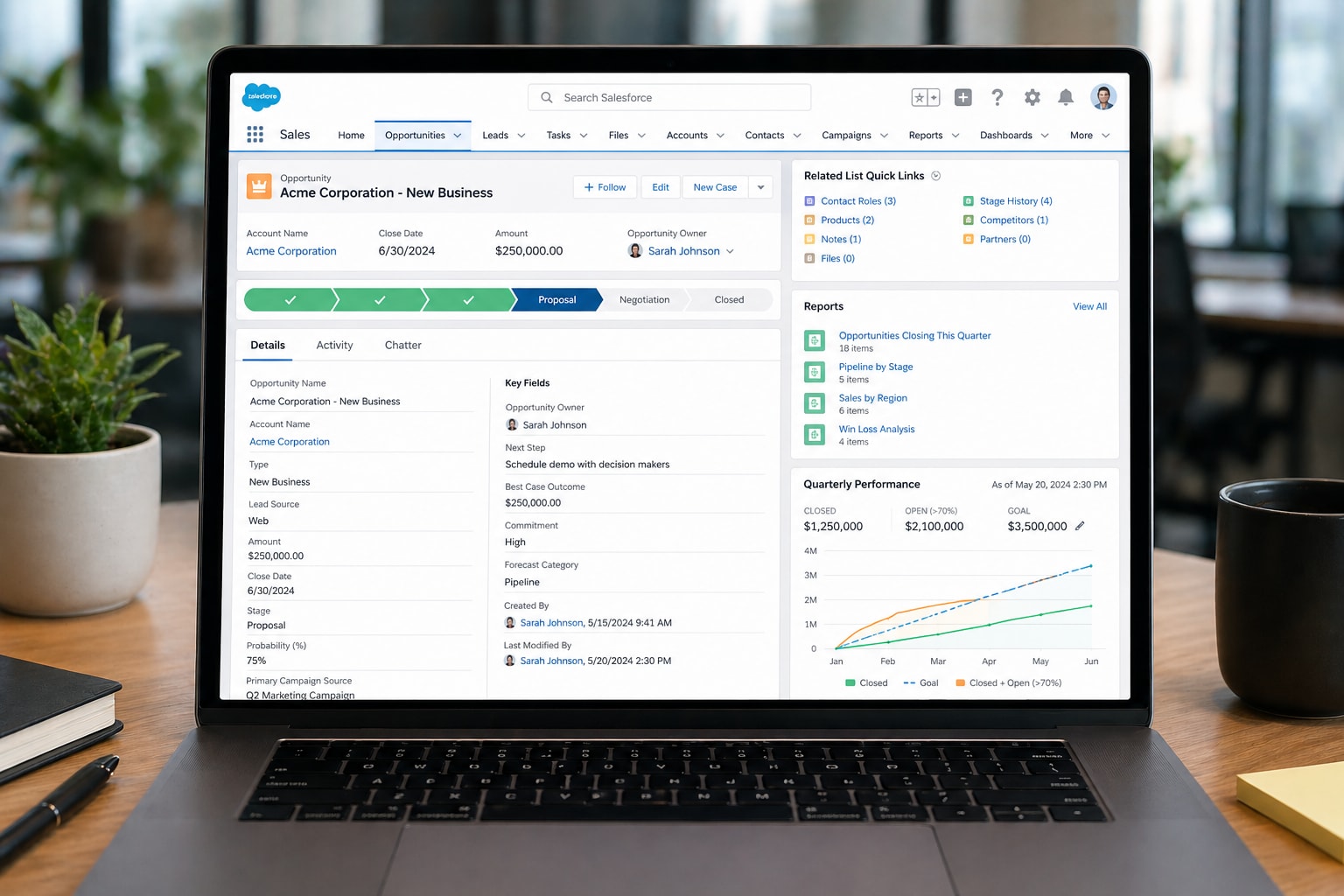
Salesforce Strengths: Where It Wins
Customisation Depth and Flexibility
Salesforce's customisation capabilities are unmatched in the CRM market. Custom objects, custom fields, custom page layouts, custom workflows, custom reporting, and a full programmatic development environment (Apex and Lightning Web Components) mean that virtually any business process can be built and automated within Salesforce. For businesses with complex, non-standard sales processes or highly specific operational requirements, this flexibility is genuinely valuable and often decisive. HubSpot's customisation is extensive but it operates within defined platform boundaries that Salesforce does not have.
Salesforce AdvantageEnterprise Scalability and Ecosystem
Salesforce has been the enterprise CRM standard for over two decades. It scales to tens of thousands of users, integrates with virtually every enterprise software system through its AppExchange marketplace (over 7,000 apps), and has the deepest partner and consultant ecosystem of any CRM platform. For large enterprises with complex organisational structures, multiple business units, and sophisticated integration requirements, Salesforce's maturity as an enterprise platform is a genuine advantage. Understanding how Salesforce fits into a broader RevOps framework is essential for getting maximum value from the platform at enterprise scale.
Salesforce AdvantageAdvanced Reporting and Analytics
Salesforce's reporting engine is significantly more powerful than HubSpot's at the enterprise level. Custom report types, cross-object reporting, joined reports, historical trending, and Einstein Analytics give data teams the flexibility to answer virtually any business question from CRM data. HubSpot's reporting has improved considerably but it still lags Salesforce for complex, multi-dimensional reporting requirements. For businesses where data analysis and business intelligence are central to decision-making, Salesforce's reporting depth is a meaningful advantage. This connects to why Salesforce setup quality matters so much for reporting accuracy.
Salesforce AdvantageHow to Choose: Decision Framework

Choosing between HubSpot and Salesforce is not a technical decision. It is a business decision. The most important inputs are your team size, your technical capability, how quickly you need to be operational, and what you actually need the CRM to do in the next two to three years.
The businesses that make the wrong choice almost always do so because they evaluated features rather than fit. A feature-rich platform that never gets properly adopted delivers less value than a simpler platform that your team uses consistently every day.
Side by Side Comparison Checklist
- Choosing Salesforce because it sounds more enterprise even though your team size and complexity do not justify it
- Choosing HubSpot because it is easier then hitting its customisation limits two years later as the business scales
- Evaluating features in demos rather than testing actual daily workflows your team will use
- Underestimating the ongoing admin cost of Salesforce: most deployments need a dedicated admin or regular partner support
- Not involving the sales team in the decision and ending up with a CRM they refuse to use
- Deciding based on price alone without accounting for implementation, training, and ongoing maintenance costs
Whichever platform you choose, implementation quality determines outcomes more than platform choice. A well-implemented HubSpot consistently outperforms a poorly implemented Salesforce, and vice versa. Understanding how your CRM connects to your broader RevOps strategy is as important as the platform decision itself. And if you are already on HubSpot and evaluating whether it still fits your needs, our HubSpot setup checklist helps you assess whether the issue is the platform or the configuration.
If you want an honest recommendation based on your specific situation rather than a generic comparison, talk to the Tech Striker team. We implement both platforms and will tell you directly which one fits your business better.
- HubSpot wins on ease of use, implementation speed, and unified marketing and sales tools. Salesforce wins on customisation depth, enterprise scalability, and advanced reporting.
- HubSpot is typically the better choice for small to mid-size businesses, teams without dedicated CRM admins, and businesses where marketing and sales alignment is a priority.
- Salesforce is typically the better choice for enterprise businesses, complex custom processes, large teams, and organisations with technical resources to manage it properly.
- Implementation quality matters more than platform choice. A well-configured HubSpot consistently outperforms a poorly implemented Salesforce for the same business.
- The most common mistake is choosing based on features or brand perception rather than actual fit with your team size, technical capability, and business complexity.